


Customer care and customer service sound like the same thing, but shoppers feel the gap between them. In a 2025 customer experience survey, 52% of consumers said they stopped buying from a brand after a bad experience with its products or services, and 29% left because of poor customer experience. Both numbers show how quickly one weak interaction can cost you a customer.
Knowing how customer care and customer service differ helps you decide where your team should invest its time. This guide defines both terms, compares them side by side, and shows how real brands put care into practice. Here is what you will learn:
Customer Service Meaning: What Is Customer Service?
Customer service meaning is simple: it is the help a business gives customers before, during, and after a purchase. It covers everything from answering a sizing question to fixing a missing order.
Customer Service Definition
Customer service is the assistance a company provides so customers can choose, use, and fix the products or services they buy. It includes answering questions, processing returns, resolving complaints, and tracking orders. The dictionary definition of customer service describes it as support tied directly to a business's products or services.
Most customer service is reactive. A customer has a question or a problem, and an agent responds. That makes service essential, but it also means the interaction usually starts only when something needs fixing.
What Customer Service Looks Like in E-Commerce
In E-Commerce, customer service covers the daily work behind a smooth order. Strong E-Commerce customer service usually includes tasks like these:
Brands with high ticket volume often add dedicated support agents so response times stay steady during busy seasons.
What Is Customer Care?
Customer care is the way a company treats customers in every interaction with the brand. It builds an emotional connection through kindness, respect, and understanding, so customers feel valued as people and not just as ticket numbers.
Many teams assume customer care belongs only to the support department. In reality, it works best as a shared habit across every team that touches the customer.
Core Traits of Customer Care
Why Customer Care Matters
Customers stay loyal to brands that make them feel valued. The payoff shows up in several places:
Difference Between Customer Service and Customer Care
The difference between customer service and customer care comes down to scope and attitude. Customer service solves the specific problem in front of you. Customer care shapes how the customer feels about the entire relationship.
Service is a function of the support team. Care is a standard the whole company can hold.
Customer Care vs Customer Service at a Glance
| Factor | Customer Service | Customer Care |
|---|---|---|
| Focus | Solving a specific question or issue | Building a lasting relationship |
| Approach | Mostly reactive | Proactive |
| Timing | When a customer needs help, often after a purchase | Across the whole buyer's journey |
| Scope | The support team | Every team in the company |
| Tone | Efficient and accurate | Empathetic and personal |
| Goal | Resolve the issue | Make the customer feel valued and loyal |
| Measured by | Response time, resolution time, tickets handled | CSAT, NPS, retention, and written feedback |
| Example | Processing a return | Checking in after the return to confirm the customer is happy |
Reactive vs Proactive
The gap between customer service vs customer care shows up most clearly in timing. A service agent responds after a customer writes in. A care-minded team spots the problem first.
For example, an order delay notice sent before the customer asks prevents a ticket and builds trust. Proactive updates also protect your queue from avoidable spikes.
Transactions vs Relationships
Each service ticket is a single transaction with a clear end point. The issue gets resolved, and the ticket closes.
Care looks past the ticket. After the fix, a care-focused agent might confirm the solution worked or note a preference for next time. Over months, those small moments turn one-time buyers into repeat customers.
How Each One Is Measured
Customer service teams usually track speed and volume, such as first response time, resolution time, and tickets handled. Customer care leans on satisfaction and loyalty signals like CSAT, Net Promoter Score (NPS), and retention rate.
You need both sets of numbers. Fast answers mean little if customers still feel unheard.
How Customer Care and Customer Service Work Together
Customer care and customer service are partners, not rivals. Service provides the structure: channels, processes, and fast answers. Care provides the human touch that makes those answers feel genuine.
Think of customer service as a core part of customer care. Without reliable service, warmth alone cannot fix a broken order.
The two also meet before a purchase. A chat that guides a shopper to the right product is both a service task and a care moment, which is why some brands add pre-sale live chat support to their team.
Where Customer Support and Customer Experience Fit In
Two related terms often join this conversation. Customer support usually means the technical, problem-solving side of service, such as troubleshooting a product.
Customer experience (CX) is the widest lens. It is the sum of every touchpoint, from the first ad to the follow-up after delivery. Service and care both feed CX, and CX belongs to the whole company.
Customer Care Examples From Brands That Go Above and Beyond
Small gestures often leave the biggest impression. These three brands show what customer care looks like in practice.
Uncommon Goods
Mother's Day and Father's Day can bring up painful memories for some people. Uncommon Goods, along with brands like Etsy, Kitsch, and Away, lets customers opt out of marketing emails tied to those holidays.
It is a small gesture, but the comments under the brand's Instagram post show how much it meant. Customers thanked the brand and even asked for the same option for Father's Day.

Chewy
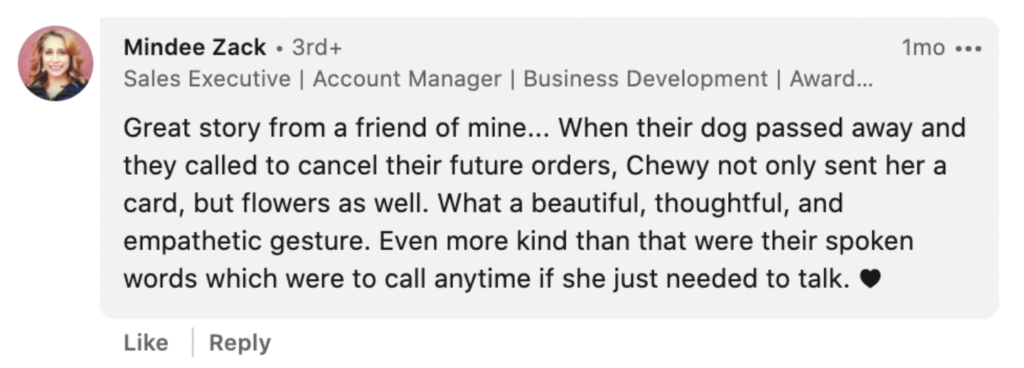
Chewy delivers pet food and supplies to millions of customers. According to a story shared on LinkedIn, one customer contacted the company to cancel future orders after her dog passed away. Chewy reportedly sent her a card and flowers, and the team told her she could call anytime if she needed to talk.
The lesson does not depend on every detail. The team treated a cancellation as a human moment, not a lost sale, and that shows the people behind the brand.
Stitch Fix
Stitch Fix helps busy shoppers find personalized pieces without visiting a store. Because shopping can feel stressful, the company has widened its offer over the years. It now carries styles for women, men, kids, maternity, and big and tall, from 1,000+ brands, in a broad range of sizes.
It also offers free shipping, exchanges, and returns, so shoppers can swap sizes or try new styles without extra cost. For retail brands, that kind of low-friction policy is care built into the process.

How to Deliver Excellent Customer Care and Customer Service
You do not need a huge budget to raise your care standard. These five steps improve care and service at the same time.
Ask for helpful feedback
Surveys do more than track your top E-Commerce metrics. When customers see that their input changes something, they become part of the brand.
Take accountability
Mistakes happen in every business. When they do, do not wait for customers to reach out.
Empower agents to add a personal touch
The Uncommon Goods and Chewy stories happened because people felt free to act with empathy. Your agents need the same room to use their judgment.
Follow up proactively
A quick follow-up shows customers that the conversation did not end when the ticket closed.
Automate routine tickets so people can focus on care
Simple, repeated questions like order status do not need a human every time. Using automation for simple tickets gives agents more time for the conversations that call for empathy.
Common Customer Care and Customer Service Mistakes
Even well-meaning teams fall into a few predictable traps. Watch for these:
Customer Care in Action: Results From Real E-Commerce Teams
Customer care is easier to trust when you can see the numbers. These two brands built support teams that protect satisfaction and retention.
Thoughtful, proactive care can be the difference between loyal customers and disappointed ones. TalentPop trains dedicated agents in top E-Commerce tools and in the judgment calls that build emotional connection.
FAQ
What is the difference between customer service and customer care?
Customer service solves specific problems, usually after a customer reaches out. Customer care builds a lasting relationship through proactive, empathetic, and personal treatment across the whole customer journey.
What is the meaning of customer service?
Customer service is the support a business gives customers before, during, and after a purchase. It includes answering questions, resolving issues, and helping customers get value from a product or service.
Is customer care part of customer service?
It works the other way around. Customer service is a core part of customer care, while care also reaches into sales, marketing, and operations. A team can deliver service without care, but strong care always relies on solid service.
Is customer care the same as customer support?
No. Customer support usually focuses on technical, problem-solving help, such as troubleshooting a product. Customer care is broader and centers on the relationship and the emotional connection with the customer.
Can a business have customer service without customer care?
Yes. A team can answer tickets quickly and still sound cold or rushed. That resolves the issue, but it does little to build loyalty.
What are examples of customer care?
Examples include letting customers opt out of holiday emails, as Uncommon Goods does, and sending a proactive delay notice before anyone asks. Following up after a return to confirm the customer is happy is another simple example.
How do you measure customer care?
Most teams track CSAT, Net Promoter Score, and customer retention. Written feedback adds context that numbers alone cannot show.
Can outsourced agents deliver real customer care?
Yes, when they receive thorough training, clear guidelines, and room to use judgment. Ancient Nutrition raised its retention rate by 5% with an outsourced team that handled cancellations proactively.
Conclusion
Customer care and customer service serve different purposes, and strong E-Commerce brands invest in both. Service resolves the issue in front of the customer, while care shapes how that customer feels about the whole relationship. Start with small, proactive habits such as honest updates, thoughtful follow-ups, and agents who feel free to show empathy. Over time, those habits turn satisfied shoppers into loyal ones.

Need Help With Customer Service?
Book a call with one of our specialists today to see how TalentPop can assist you with putting together a solution for your customer service needs.
Book a CallNeed Help With Customer Service?
We're elevating customer experiences at 500 top E-Commerce brands (and counting). Let's see what we can do for you!
Get Started

.png)

.png)
.png)


