Holiday customer service decides whether your busiest weeks turn into loyal customers or a pile of refund requests. November and December bring in about 19% of annual retail sales on average across the last five years, and the share climbs higher for many E-Commerce brands. That puts a wave of new orders, gift questions, and shipping worries in your inbox at the same moment. The brands that stay calm are the ones that planned their support before the first promotion went live.
Here is the short answer on how to handle seasonal customer support spikes. Reduce avoidable tickets before BFCM, forecast volume from last year's data, add flexible capacity, and have all of it in place by early November. If a Black Friday inbox has ever felt like a red alert on repeat, this plan is built for that moment.
A holiday rush rewards preparation and punishes improvisation. These are the four moves that matter most:
Why Support Tickets Spike During the Holidays
What can lead to spikes in customer service tickets? For E-Commerce brands, the holidays explain most of it, especially when you run ads for great deals and specials. Four patterns show up every year, and each one calls for a slightly different fix.
WISMO and Shipping Delays
Where is my order (WISMO) tickets climb fastest once carriers get busy and delivery windows stretch. Every delayed package turns into an email, a chat, or a call. The more visible your tracking and shipping deadlines are, the fewer of these questions ever reach an agent.
Gift, Promo, and Discount Questions
Big offers bring first-time shoppers, and first-time shoppers ask more questions before they buy. Expect questions about promo codes, stacking discounts, gift receipts, price adjustments, and bundles. These questions are predictable, which makes them ideal for templates and automated replies.
January Returns
The peak does not end on December 31. In its 2025 returns report with Happy Returns, NRF found that retailers expected 17% of holiday sales to be returned, and an estimated 19.3% of online sales to go back for the full year. About 43% of surveyed retailers also planned to hire seasonal staff to manage returns. Plan your January capacity now, not in January.
Other Triggers: New Markets, Seasonal Trends, and Outages
Holidays are not the only cause. These situations also send ticket counts up:
Whatever the cause, the goal stays the same: be prepared for anything and keep customer satisfaction at the top of your list.
How Much Will Your Ticket Volume Increase?
You do not need a perfect model. You need a defensible one built on your own history. NRF projected that 2025 holiday sales would grow between 3.7% and 4.2% and pass $1 trillion for the first time. Market growth gives useful context, but your own ticket data is a better guide than any industry average.
Use this simple formula: forecast tickets = last year's tickets in the same window × (1 + order growth) × (1 + promo lift). Then convert the result into agents. The table below walks through an illustrative example, and every number in it is hypothetical, so swap in your own.
| Step | What to do | Illustrative example |
|---|---|---|
| 1. Baseline | Pull the tickets you received during BFCM week last year. | 1,200 tickets |
| 2. Order growth | Apply the order growth you expect this year. | 1,200 × 1.25 = 1,500 tickets (25% more orders) |
| 3. Promo lift | Add the effect of bigger offers, new ads, or new channels. | 1,500 × 1.15 = 1,725 tickets (15% lift) |
| 4. Daily average | Divide by the number of days in the window. | 1,725 ÷ 7 = about 246 tickets per day |
| 5. Agents needed | Divide by the tickets one agent can resolve per day. | 246 ÷ 40 = 6.2, so plan for 7 agents |
Averages hide the real shape of demand. Black Friday and Cyber Monday will run well above the daily average, so plan extra coverage for those days and for the first hours of every major promotion.
Your Holiday Support Timeline
A clear timeline turns holiday readiness from a vague worry into a checklist with dates. Work backward from Black Friday and give every task an owner.
How Early Should I Prepare Customer Service for the Holidays?
Start about eight weeks before Black Friday, and treat early November as the deadline for having staffing, SOPs, and automations live. Black Friday lands in late November, so eight weeks out falls in early October. If the busy season is only a few weeks away, it is not too late: an outsourcing partner can still bring trained agents onboard to help with ticket spikes.
8 Weeks Out
4 Weeks Out
BFCM Week
December
January
Steps You Can Take To Manage Holiday Ticket Spikes
The best plan works in a fixed order: shrink the number of tickets, add capacity for what remains, schedule that capacity around the real peaks, and protect the people doing the work. These four steps follow that order.
Step 1: How Can I Reduce Support Tickets During the Holidays?
Every ticket you prevent is one you never have to staff for. Start with the questions customers ask most.
Check out the SOP below that we created for our client JAXXON.
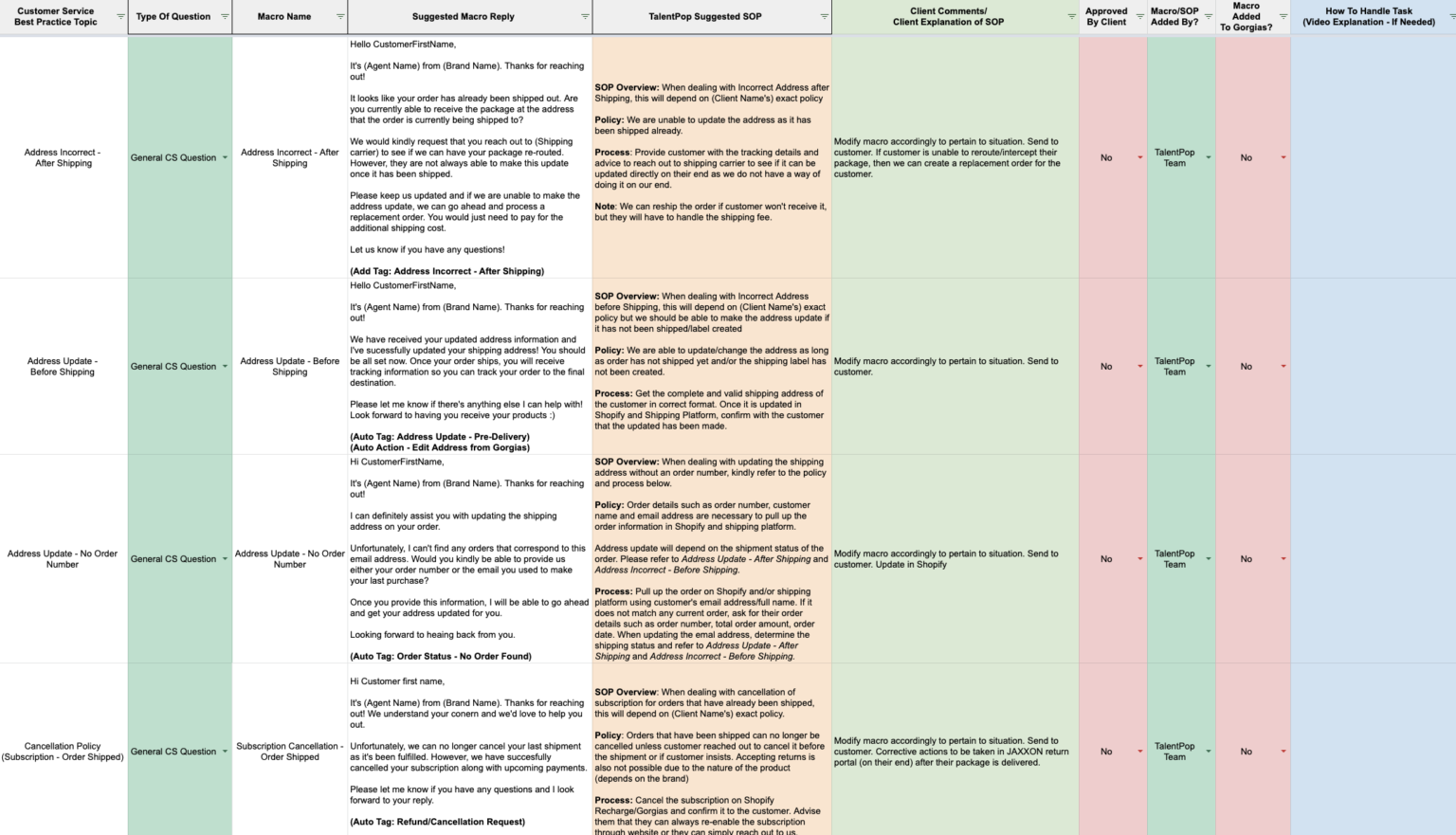
SOPs not only decrease response and resolution times for tickets, but they also create consistency around how inquiries are handled by your team.
Step 2: How Do I Handle a Spike in Support Tickets by Adding Capacity?
How do I handle a spike in support tickets? Reduce what comes in, then add capacity for what remains. Seasonal customer service and seasonal staffing usually come down to three options, and many brands combine them.
| Option | Best for | Speed to start | Cost pattern | Main risk |
|---|---|---|---|---|
| Seasonal hires | Predictable peaks when you have months to recruit and train | Slow: recruiting, hiring, and training all come first | Payroll, recruiting, equipment, and training time | Turnover after the peak and a heavy training load on your team |
| Outsourcing | Flexible capacity you can scale up before the peak and down after it | Faster than hiring: agents arrive already trained on common tools | Hourly rate, with terms that let you adjust the team size | Needs clear SOPs and a strong handoff |
| AI automation | Repetitive questions such as order status and return policy | Depends on setup and testing before it goes live | Setup cost, then a low cost per resolved ticket | Weak on emotional or complex cases without human backup |
Watch your tools as well as your headcount. If your helpdesk charges per seat, every temporary agent adds to the bill, so check the pricing model before you scale. Brands that prefer to hire directly can shorten the search with direct hiring shortlists instead of sorting through applications alone.
Can AI Handle Seasonal Customer Support Spikes?
AI can handle the repetitive part of seasonal customer support spikes. Order status, return policy, and shipping cutoff questions follow the same pattern every time, so they are good candidates to automate. Keep humans on refunds, complaints, and anything emotional, and give customers an easy way to reach an agent.
Should You Outsource Holiday Support?
Should I hire seasonal agents or outsource? Hire seasonally when you have months of lead time, a strong training process, and a peak that stays predictable. Outsource when you need trained people fast, want to scale down after January, or cannot spare managers to train new hires. Look for month-to-month terms, agents already trained on your helpdesk, and quality assurance. Dedicated customer service agents matter most when order volume jumps, and support built for E-Commerce brands means less time explaining how your store works.
Core Metrics: 17 agents, 2m 12s first response time, and $100K+ in revenue generated during BFCM.
The lesson for your own plan is timing. JAXXON did not wait for the next rush to fix what went wrong in the last one, and its BFCM results came after that preparation.
Step 3: How to Manage Staffing During Ticket Spikes and Schedule for BFCM Week
How to manage staffing during ticket spikes comes down to matching people to the shape of demand, not to the daily average. Holiday staffing works when your schedule follows your busiest hours and your busiest days.
How Many Extra Agents Do I Need for Black Friday?
Divide your forecast daily tickets by the number of tickets one agent resolves per day, then round up and add a buffer for breaks, sick days, and the busiest days. Our staffing calculator, built from our work with 750+ E-Commerce brands, predicts headcount with four different methods. Use it to cross-check your number and see whether your estimate is too low.
Black Friday Checklist for Support Teams
Use this BFCM checklist as your final Black Friday preparation review:
Step 4: Protect Quality and Avoid Burnout
At peak season, your customer service team carries most of the weight. To avoid burning out agents and stretching them too thin, give them real support before the rush starts.
Common Holiday Support Mistakes to Avoid
After the Peak: Clearing the Backlog and Handling January Returns
Once the last big sale ends, your queue does not clear itself. Tickets from the final shipping cutoffs, gift returns, and exchange requests arrive for weeks. A short recovery plan keeps customers from feeling forgotten.
Holiday Customer Service Support from TalentPop
Peak season is the hardest time to build a team from scratch, which is why so many brands bring in extra hands for it. At TalentPop, we help E-Commerce brands add trained agents for the busy season through seasonal staffing that is flexible by design: no long-term contracts, month-to-month terms, and the freedom to scale down when the rush ends. Our agents complete 20 hours of training on Shopify, E-Commerce best practices, and helpdesk tools before they join your queue.
JAXXON's BFCM results show what early planning and pre-trained agents can do, but a late start is not a lost cause. Even if the busy season is only a few weeks away, we can bring someone onboard to help with your ticket spikes.
Get holiday coverage in place before the rush starts. Even with only a few weeks to go, we can bring an agent onboard to help with ticket spikes.
FAQ
How early should I prepare customer service for the holidays?
Start about eight weeks before Black Friday. Use the first weeks to audit last year's tickets, build a forecast, and choose how to add capacity, then make sure staffing, SOPs, and automations are live by early November. If you are closer to the season than that, outsourcing can still add trained help in time.
How do I handle a spike in support tickets?
Reduce avoidable tickets first with shipping deadlines, a clear return policy, and automated order updates. Then add capacity for what remains through seasonal hires, outsourcing, or AI, and schedule your team around peak days and hours.
How many extra agents do I need for Black Friday?
Forecast your ticket volume, divide it by the tickets one agent resolves per day, and round up. Add a buffer for breaks and absences, and staff more heavily on Black Friday and Cyber Monday than the average suggests.
How can I reduce support tickets during the holidays?
Publish shipping deadlines, write a clear holiday return policy, update your FAQ, and automate order status updates. Refresh auto-replies and live chat messages so common questions get answered before a customer reaches an agent.
Should I hire seasonal agents or outsource?
Hire seasonally if you have months to recruit and train and your peak is predictable. Outsource if you need trained agents quickly, want to scale down after January, or cannot spare managers for training.
How do I forecast holiday ticket volume?
Start with last year's tickets for the same window, then apply your expected order growth and promo lift. Convert the result into a daily average and divide by the tickets one agent handles per day.
Can AI handle holiday customer service?
AI works well for repetitive questions such as order status, shipping cutoffs, and return policy. Keep human agents on refunds, complaints, and sensitive situations.
Conclusion
Holiday customer service works best when preparation starts while the calendar still feels quiet. Ticket spikes are predictable: they come from shipping questions, promotions, and returns, and last year's data can size them. The brands that handle them well cut avoidable tickets first, match staffing to the shape of demand, and protect their agents so quality holds through the final week of December. A team that finishes this work by early November enters the season with fewer surprises and leaves January with clean data for next year's forecast.

Need Help With Customer Service?
Book a call with one of our specialists today to see how TalentPop can assist you with putting together a solution for your customer service needs.
Book a CallNeed Help With Customer Service?
We're elevating customer experiences at 500 top E-Commerce brands (and counting). Let's see what we can do for you!
Get Started