


Knowing how to measure customer satisfaction starts with picking the right combination of metrics, not sending out one generic survey and hoping for the best. Nearly three quarters of companies, 72%, never review customer experience data with their whole team, which quietly widens the gap between what customers expect and what they actually receive. That gap matters: recent industry research puts the average CSAT score across industries at 78 out of 100, while top performing support teams now aim for a benchmark of 85% or higher. For E-Commerce brands especially, tracking the right KPIs is the difference between guessing why customers churn and knowing exactly where to fix the experience.
Why Measuring Customer Satisfaction Matters for E-Commerce Growth
Customer satisfaction data tells you whether your product, support team, and overall experience are meeting expectations before a customer quietly switches to a competitor. Without it, decisions about staffing, refund policy, or shipping speed are just guesses. Brands that consistently track satisfaction can catch a service breakdown weeks before it shows up as lost revenue.
This applies across nearly every vertical, whether you run an online store, a subscription software product, or a multi-location retail brand. The touchpoints will differ by business model, but the seven metrics below cover almost every scenario.
How to Measure Customer Satisfaction: A Quick Process First
Before diving into the metrics themselves, get the basics right. Send the survey immediately after the interaction closes rather than days later, since a customer's memory of the specific moment fades fast. Match the survey to the right touchpoint, post-purchase, post-support-ticket, or a periodic relationship check, and use the metric breakdown below to decide which number actually answers your question.
7 Customer Satisfaction Metrics & KPIs to Track
There is no single customer satisfaction metric that tells the whole story. Most support and CX teams track a combination of the seven below, each answering a different question about the customer relationship.
Customer Satisfaction Score (CSAT)
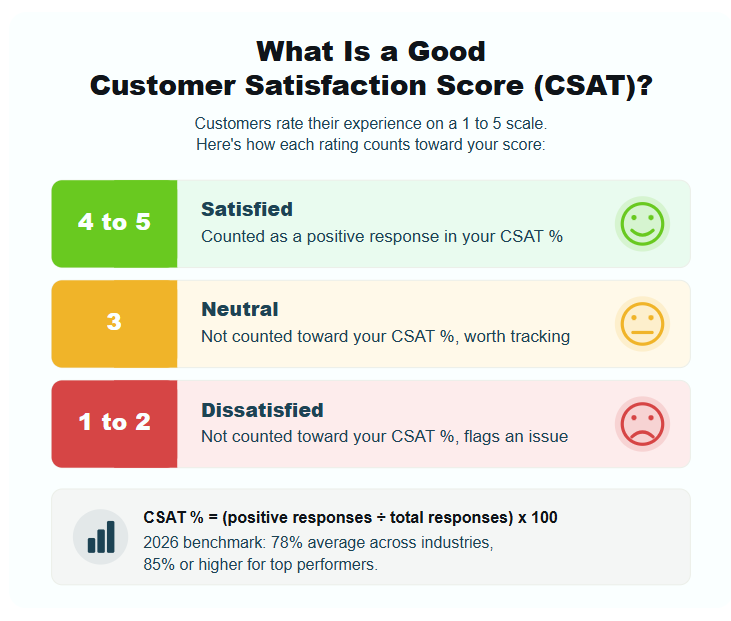
CSAT is the most direct customer satisfaction measurement available. After an interaction, customers rate their experience on a scale, typically 1 to 5, and you calculate the score using this formula:
CSAT % = (Number of positive responses, 4 and 5 stars ÷ Total number of responses) × 100
A score above 75% is generally considered healthy, and current benchmarks put the cross-industry average at 78%, with a target of 85% or higher for top performers.
Net Promoter Score (NPS)
NPS asks a single question: how likely is this customer to recommend your business to someone else, on a scale of 0 to 10. Responses sort customers into three groups.
Calculate NPS by subtracting the percentage of detractors from the percentage of promoters. The result ranges from negative 100 to positive 100, and current benchmarks put a healthy B2C average around 49, with B2B averaging closer to 38.
Customer Effort Score (CES)
CES measures how much effort a customer had to put in to resolve an issue, rather than how they felt overall. It is one of the strongest predictors of loyalty, since a high-effort experience is far more likely to push a customer toward a competitor even if the issue was eventually resolved.
Score the responses on a 1 to 7 scale, from Strongly Disagree to Strongly Agree, then calculate CES using this formula:
CES = Total sum of responses ÷ Number of responses
A CES in the 5 to 7 range signals a low-effort, positive experience, while a score of 1 to 3 flags friction that needs attention.
SERVQUAL
SERVQUAL evaluates the gap between what a customer expected from your service and what they actually experienced, scored across five dimensions: reliability, assurance, tangibles, empathy, and responsiveness. It takes more effort to run than CSAT or NPS, but it is useful when you need to diagnose exactly which part of the service experience is underperforming.
Retention Rate
Retention rate tracks the percentage of customers who stay with your brand over a given period. It is a lagging indicator of satisfaction: if CSAT and NPS are strong but retention is falling, that usually points to a pricing or product issue rather than a service quality problem.
Churn Rate
Churn rate is the inverse view of retention, the percentage of customers who leave within a given period. Watching churn alongside CSAT and CES helps you confirm whether a dip in satisfaction is actually costing you customers, or whether it is a short-term blip.
First Contact Resolution (FCR)
FCR measures the percentage of customer issues resolved in a single interaction, with no follow-up required. It is one of the strongest predictors of CSAT, since customers who have to reach out more than once about the same issue report sharply lower satisfaction. Current benchmarks put average FCR around 70%, with top performers reaching 85% or higher.
Customer Satisfaction KPI Benchmarks in 2026
Use the table below to check whether your current numbers are on par with industry standards, or quietly falling behind.
| Metric | 2026 Benchmark | What It Signals |
|---|---|---|
| CSAT | 78% average, 85%+ for top performers | Satisfaction with a single interaction |
| NPS | 49 (B2C), 38 (B2B) | Likelihood to recommend and repurchase |
| CES | 5 to 7 out of 7 is healthy | How much effort a resolution required |
| FCR | 70% average, 85%+ top performers | Issues solved on the first contact |
| Retention | Benchmark varies by industry | Customers staying over time |
| Churn | Lower is better, track against your baseline | Customers leaving over time |
Common Mistakes When Measuring Customer Satisfaction
How to Act on Low Customer Satisfaction Scores
A low score across any of these seven metrics is only useful if it leads to a change. That usually means adding trained support capacity at the exact touchpoint that is underperforming, automating the repetitive tickets dragging down first contact resolution through simple helpdesk automation, or bringing on a specialized hire through a direct recruitment search when the gap is a skills issue rather than a volume issue.
Retention is often the metric that moves once satisfaction issues are actually resolved rather than just measured.
If your CSAT, NPS, CES, or FCR numbers are pointing to a gap in support coverage, our team can help you close it with trained agents ready to plug in fast.
FAQ
What are the 7 metrics for measuring customer satisfaction?
The seven most commonly tracked are CSAT, NPS, CES, SERVQUAL, Retention Rate, Churn Rate, and First Contact Resolution (FCR). Together they cover interaction-level feedback, loyalty, effort, service quality gaps, and business outcomes.
What is a good CSAT score in 2026?
A CSAT score of 75% or higher is generally considered healthy, with the cross-industry average sitting around 78% and top performers targeting 85% or above.
How often should you measure customer satisfaction?
Interaction-level metrics like CSAT and CES should be collected after every support ticket or purchase. Relationship-level metrics like NPS work best on a quarterly or biannual cadence.
What is a CSAT KPI, and how is it different from NPS?
A CSAT KPI tracks satisfaction with one specific interaction, while NPS measures a customer's overall likelihood to recommend the brand based on the full relationship. Both are useful, but they answer different questions.
Which customer satisfaction metric matters most?
No single metric matters most on its own. CSAT and FCR are the two most predictive of day-to-day satisfaction, but pairing them with NPS and retention data gives the clearest picture of long-term customer health.
Conclusion
Measuring customer satisfaction is not about picking one perfect metric. It is about tracking CSAT, NPS, CES, SERVQUAL, retention, churn, and FCR together, then checking those numbers consistently against your own baseline. Businesses that build this habit catch problems early, and those that skip it usually find out too late, once the customer has already left.

Need Help With Customer Service?
Book a call with one of our specialists today to see how TalentPop can assist you with putting together a solution for your customer service needs.
Book a CallNeed Help With Customer Service?
We're elevating customer experiences at 500 top E-Commerce brands (and counting). Let's see what we can do for you!
Get Started


