


Your customers already expect help in your comments and DMs. 73% of social media users expect brands to respond within 24 hours, and 40% of shoppers expect a reply within an hour. That makes social media customer service a frontline support channel, not a side task for your marketing team. How you handle it shapes loyalty, reviews, and revenue.
The stakes are public, too. 63% of consumers say the quality of a brand's social support significantly influences their loyalty, yet only 20% of brands have a well-defined social care strategy. This guide closes that gap with a practical framework built for E-Commerce teams.
In this guide, you'll learn:
What Is Social Media Customer Service?
Social media customer service is the practice of answering questions, resolving issues, and responding to feedback on platforms like Instagram, Facebook, TikTok, X, and WhatsApp. It covers public comments, direct messages, tags, reviews, and posts where customers mention your brand without tagging you. Many teams call it social customer service or social customer care. The label changes, but the goal stays the same: fast, helpful answers where your customers already spend their time.
For E-Commerce brands, customer service on social media spans the entire buying journey. A shopper might ask about sizing in your Instagram DMs, complain about a late package in a TikTok comment, and leave a glowing review on Facebook, all in the same month. Each of those moments is a chance to earn trust or lose it.
Social Customer Service vs. Social Media Marketing
Social media marketing is about reach: content, campaigns, and community growth. Social customer service is about resolution: fixing problems and answering questions until the customer is satisfied. The two overlap because every public reply is also a piece of brand content that other shoppers read.
Trouble starts when nobody owns that overlap. Content creators get pulled into refund conversations, and support agents never see the complaints sitting in the comments. The strongest brands split the work clearly, with marketing owning content and community while support owns every issue that needs an answer.
Public Replies vs. Private DMs: The Two Sides of Social Care
Social care happens in two places. Public interactions include comments, tags, mentions, and reviews that anyone can see. Private interactions happen in DMs and messaging apps, where customers share order numbers, addresses, and account details.
Each side needs a different approach. Public replies should be short, warm, and visible proof that you care. Private conversations are where the real troubleshooting happens, so they need the same order access and resolution tools your email team uses.
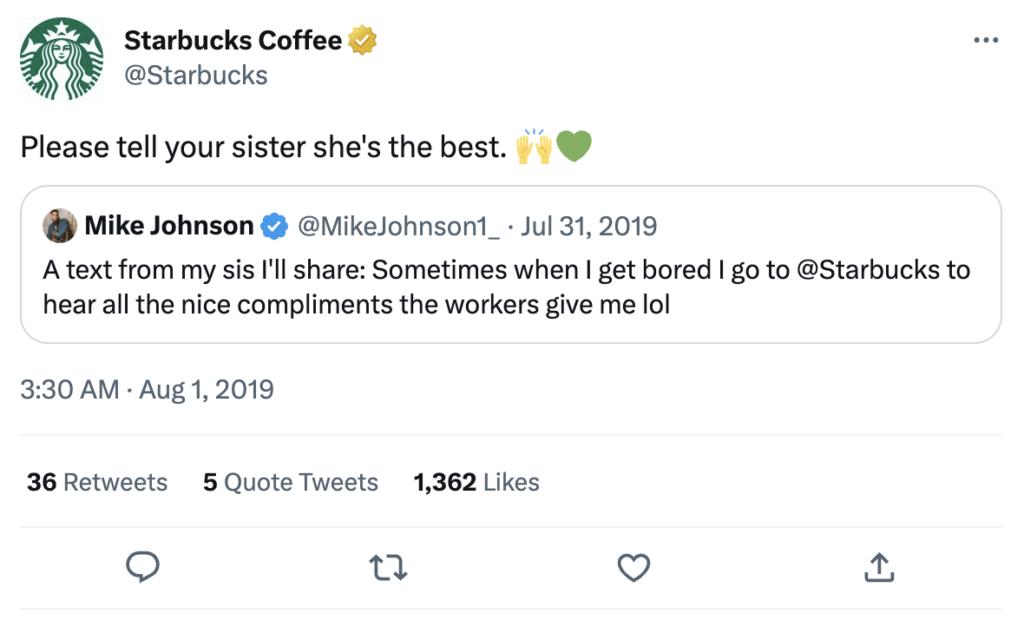
For feedback that doesn't require action, a short public reply is all you need. Your team can simply write, "Thanks for letting us know, {Customer Name}! We'll be here if you need any assistance."
Here is a similar exchange between Starbucks and a customer on X:
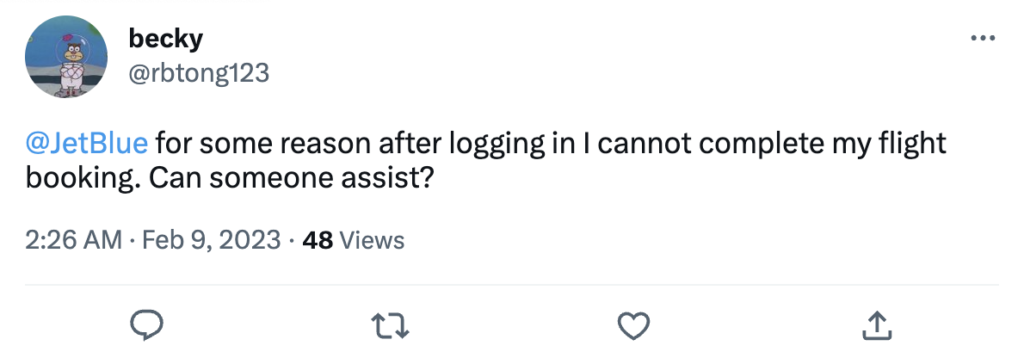
For inquiries that require action, such as asking the customer to call or share private details, respond to the post publicly first. Let the customer know how you plan to resolve the issue, then continue the conversation in DMs.
Here is an example of a JetBlue customer asking for help in public:
Why Customer Service on Social Media Matters for E-Commerce Brands
Social support is not a vanity channel. Handled well, it protects your reputation, lifts conversion, and keeps support costs in check at the same time. Here is why it deserves a real seat in your support operation.
Every Reply Is Public (Reputation Management)
An unhappy email stays in one inbox. An unhappy comment sits under your latest post, where every future customer can read it and see whether you answered. Silence reads as indifference, and a slow reply can turn one complaint into a long thread.
The upside is just as public. A fast, genuine fix shows shoppers exactly how you treat people when something goes wrong. That proof is often more persuasive than any ad you run.
Social Media Customer Support Removes Pre-Purchase Friction
Plenty of social messages are not complaints at all. They are buying questions: Does this run small? Will it ship before Friday? Is this safe for sensitive skin? Every unanswered question is a sale that may never happen.
Treating DMs as a sales channel changes the math. When agents answer pre-sale questions within minutes and share a direct product link, social media customer support becomes a revenue driver instead of a cost center.
It Costs Less Per Contact Than Phone Support
Agents can manage several social and chat conversations at once, while a phone agent handles one caller at a time. Customers also get answers without sitting on hold. That makes social one of the most efficient channels you can offer, as long as it is staffed and organized properly.
Social Conversations Feed Product and CX Insights
Customers are brutally honest on social media. Recurring comments about a confusing size chart, a leaky lid, or slow shipping to one region are early warnings you can act on. Tag and track these themes so your product, operations, and marketing teams see the patterns, not just the individual posts.
Social Media Response Time: What Customers Expect in 2026
Speed is the first thing customers judge on social. Expectations are far tighter than on email, and many shoppers expect an answer within the hour. Research puts the outer limit at 24 hours, but waiting that long on a public complaint rarely ends well.
Use these recommended targets as a starting point for your own social media response time goals:
| Interaction Type | Priority | Target First Response | Where to Resolve |
|---|---|---|---|
| Public complaint or negative comment | HIGH | Under 1 hour | Acknowledge publicly, resolve in DMs |
| Direct message about an order issue | HIGH | Under 1 hour | Private DM or helpdesk ticket |
| Pre-sale product question | HIGH | 15 to 30 minutes during business hours | Public reply or DM with a product link |
| Product review posted on social | MEDIUM | Within 24 hours | Public reply, then DM if action is needed |
| Untagged brand mention | MEDIUM | Within 24 hours | Public reply when it adds value |
| Positive comment or praise | LOW | Same day | Public reply |
First Response Time vs. Resolution Time
First response time measures how quickly you acknowledge a customer. Resolution time measures how long it takes to actually solve the problem. Both matter, but customers remember the second one.
A fast "we're on it" buys goodwill, not forgiveness. If the fix drags on for days after a quick first reply, the customer often feels more ignored than before. Track both metrics side by side so speed never becomes a substitute for results.
How to Build a Social Media Customer Service Strategy in 7 Steps
A strong social media customer service strategy turns scattered replies into a repeatable system. Work through these seven steps in order, and your team will know exactly what to answer, where, and how fast.
Audit Where Customers Already Talk About You
Start with the channels your customers already use, not the ones you wish they used. Review the last 90 days of comments, DMs, tags, and reviews across every platform.
Decide Who Owns Social Care
Ownership gaps are the top reason social messages fall through the cracks. Only 30% of marketers feel their brand actively engages with customers on social and has the right care tools and processes in place. Decide who answers what before volume forces the decision for you.
Many brands pair someone focused on content calendars and community management with support agents who handle every resolution. That split keeps your feed on-brand and your customers taken care of.
Set Response Goals and Coverage Hours
Customers do not stop posting at 5 PM. Evenings, weekends, and holiday sales are often when social volume peaks, and they are also when in-house teams are thinnest.
Build a Triage and Escalation Matrix
Not every message deserves the same urgency. A clear triage matrix tells agents what to answer right away, what to route, and what to flag to leadership.
Write a Response Playbook and Saved Replies
A playbook keeps every agent on-brand, even on the busiest day. It should cover tone, approved phrases, what agents can offer (discounts, replacements, or refunds), and when to escalate.
Choose Your Social Customer Care Tools
Juggling native apps is how messages get missed. A helpdesk or unified social inbox pulls comments and DMs from every platform into one queue, with order data right alongside each conversation.
Track the Metrics That Matter
What you measure shapes how your team behaves. Pick a small set of metrics and review them every week.
10 Social Media Customer Service Best Practices
Once your strategy is in place, these social media customer service best practices keep quality high as volume grows. Share them with every person who touches your inbox.
Common Social Media Customer Support Mistakes to Avoid
Even experienced teams slip into habits that quietly damage trust. Watch for these mistakes as your social inbox grows.
Social Media Customer Service Examples and Reply Templates
The fastest way to raise quality is to give agents strong examples to adapt. Use these templates as a starting point, then personalize each one for the customer in front of you.
Templates for Common Social Media Scenarios
What Great Social Customer Care Looks Like in Practice
Picture a skincare brand that notices several TikTok comments asking whether a new serum is safe to use with retinol. Instead of answering each one privately, an agent pins a clear public reply and adds the answer to the product page. Future shoppers get the answer before they even ask.
Now picture an apparel brand whose customer posts a photo of the wrong item arriving. The agent replies within minutes with an apology, moves to DMs for the order number, and ships the correct item the same day. A short public follow-up closes the loop for everyone who saw the original post.
Finally, picture a coffee subscription brand during the holiday rush. Order status questions pour into Instagram DMs, so the team sends an automated reply with tracking links and routes anything more complex to a live agent. Customers get instant answers, and agents save their time for conversations that need a human.
Who Should Handle Social Customer Care? In-House vs. Outsourced Agents
Most social media customer service problems are really staffing problems. Brands know they should respond faster, but the people answering DMs are often marketers, founders, or support reps already juggling several other channels.
Here is how the most common staffing models compare:
| Model | Cost | Coverage | Ramp-Up Time | Best For |
|---|---|---|---|---|
| DIY Marketing team handles it | Hidden cost of lost content time | Business hours, often inconsistent | None, but support skills vary | Very low message volume |
| HIRE In-house support rep | Full salary, benefits, and tools | Limited to one person's schedule | Weeks of hiring and training | Steady, predictable volume |
| TEAM Dedicated outsourced agents | From $12/hr | Extended hours, nights, and weekends | Fast, with agents experienced in leading helpdesks | Growing or seasonal volume |
| AI Automation only | One-time setup plus software | 24/7 for simple questions | Setup and testing period | Repetitive order status and policy questions |
For most growing E-Commerce brands, the sweet spot is a blend: automation for the simplest questions and dedicated customer support agents for everything that needs judgment and empathy. Agents who already know tools like Shopify and Gorgias can plug into your social inbox quickly. They also keep coverage steady through launches and holidays, when in-house teams stretch thin.
Get dedicated customer service agents who reply to comments, DMs, and reviews across every platform, trained on your brand voice and your helpdesk. Plans start at $12/hr.
Frequently Asked Questions
What is social media customer service?
Social media customer service is support delivered through platforms like Instagram, Facebook, TikTok, X, and WhatsApp. It includes replying to comments, answering DMs, responding to reviews, and addressing brand mentions. The goal is to resolve questions and issues quickly, right where customers reach out.
What is a good social media response time?
Aim to respond within one hour for complaints, order issues, and pre-sale questions. Many customers expect a reply that fast, and most expect one within 24 hours at the latest. Lower-priority interactions, like praise, can wait until later the same day.
Should you respond to negative comments publicly?
Yes. A calm, public acknowledgment shows other customers that you take feedback seriously. Keep the public reply short, then move the conversation to DMs to collect order details and resolve the issue privately.
Which platforms should you offer customer service on?
Start with the platforms where customers already contact you, which for most E-Commerce brands means Instagram, Facebook, and TikTok. Add others, like X or WhatsApp, based on where your audience is active. Supporting three platforms well beats supporting six poorly.
What is the difference between social media management and social customer care?
Social media management covers content, publishing, and community growth. Social customer care focuses on resolving questions and problems. The two work best when marketing owns content and support owns resolutions, with a clear handoff between them.
How do small E-Commerce brands scale social media customer support?
Start with a shared inbox, saved replies, and clear response targets. Automate repetitive questions like order status, then add dedicated agents as volume grows so founders and marketers can step back from the inbox. Plan extra coverage before peak season rather than scrambling during it.
Turn Social Media Customer Service Into a Competitive Advantage
Social media customer service is where your brand's promises get tested in public. Every reply, or lack of one, shows shoppers how you treat people when it matters. The brands that win treat social as a true support channel, with clear ownership, fast response targets, and a playbook every agent can follow.
Start small if you need to. Audit where customers already reach you, set realistic response times, and build templates for your most common questions. As volume grows, staff for the peaks so every comment and DM gets the fast, human answer your customers expect.

Need Help With Customer Service?
Book a call with one of our specialists today to see how TalentPop can assist you with putting together a solution for your customer service needs.
Book a CallNeed Help With Customer Service?
We're elevating customer experiences at 500 top E-Commerce brands (and counting). Let's see what we can do for you!
Get Started


