Back to the Blog

Marketing

TikTok Influencer Marketing: A Complete Strategy Guide for E-Commerce Brands

Kara Peneguy
September 1, 2026
6 minutes

TikTok delivers an 11.8% short-term ROI, higher than any other social platform for influencer campaigns. 78% of TikTok users have purchased a product after seeing it in their feed. And while Instagram engagement averages 1.9%, TikTok's sits at 5.53%. The numbers aren't surprising anymore. What still catches most E-Commerce brands off guard is how much process discipline separates the campaigns that convert from the ones that burn budget and disappear.

This guide breaks down exactly how TikTok influencer marketing works, from choosing the right creator tier to structuring outreach, sending briefs, and tracking performance. It uses the same 6-step framework TalentPop's Influencer Marketing Specialists run for E-Commerce brands every day. Whether you're launching your first creator campaign or tightening up a program that isn't delivering, this is your starting point.

What Is TikTok Influencer Marketing?

TikTok influencer marketing is the practice of partnering with TikTok creators to produce short-form video content that promotes your brand to their audience. Unlike traditional paid ads, which interrupt the user experience, influencer content appears organically in the For You Page, delivered through a voice the viewer already trusts.

For E-Commerce brands, the mechanics are straightforward: identify creators whose audience matches your target customer, agree on deliverables and compensation, supply them with your product and a campaign brief, and track the resulting engagement and sales.

What separates TikTok from every other influencer platform is structural. TikTok's algorithm distributes content based on video quality and viewer behavior, not the creator's follower count. A nano-creator with 8,000 followers can generate 400,000 views if the content resonates. That reach, combined with TikTok Shop's native commerce infrastructure, makes TikTok the highest short-term ROI influencer channel available to E-Commerce brands today.

Why TikTok? The Numbers Behind the Platform's E-Commerce Power in 2026

An Algorithm Built for Discovery, Not Popularity

Every other major social platform rewards audience size. TikTok rewards content quality. The For You Page surfaces videos based on completion rate, shares, comments, and replays, which means a well-crafted product demo from a 12,000-follower creator can outperform a half-hearted post from an account with 2 million. For brands, this changes the economics of influencer marketing entirely.

You don't need to spend $25,000 on a macro deal to reach your audience. A portfolio of well-matched micro-creators, each posting authentic, niche-specific content, consistently drives stronger results at a fraction of the cost. Data backs this: micro-creators cost $0.20 per engagement compared to $0.33 for macro, a 40% efficiency gap that compounds across a multi-creator program.

TikTok Shop and the Closed-Loop Commerce Advantage

TikTok Shop removes the biggest friction point in social commerce: the gap between inspiration and purchase. Before TikTok Shop, a creator's video could spark genuine interest, but the viewer still had to open a browser, find the product, and navigate checkout. TikTok Shop collapses that entire journey into a single tap. In-video product links, affiliate tracking, and native checkout all live inside the app.

TikTok Shop's GMV reached $33.2 billion in 2024, nearly tripling from $11 billion the year prior. For brands running influencer campaigns, this infrastructure turns creator content into a directly attributable revenue channel, not just an awareness play.

What You Get Back: TikTok Influencer Marketing ROI

Influencer marketing is no longer an awareness play brands run alongside their "real" performance channels. For E-Commerce brands, it has become one of the highest-return acquisition channels available, particularly on TikTok, where the combination of algorithm-driven reach, creator trust, and native commerce infrastructure creates conditions for conversion that paid ads can't replicate.

$5.78

Average return per $1 spent

Influencer marketing delivers an average return of $5.78 for every dollar invested, with top-performing campaigns reaching $18–$20 per dollar. For E-Commerce brands that execute with the right creator mix and a structured process, the channel consistently outperforms paid social on a cost-per-acquisition basis.

75%

Of advertisers cite TikTok as their highest-ROI influencer platform

Three in four brands running influencer programs across multiple platforms report TikTok as the channel delivering the strongest return. This isn't because TikTok spends are larger, it's because the organic reach and purchase behavior on the platform amplify results in ways paid placements can't match.

86%

Of consumers make at least one influencer-driven purchase per year

Influencer-driven purchasing behavior is no longer limited to Gen Z or impulse-buy categories. Across demographics and product types, the vast majority of consumers credit creator content as a factor in at least one annual purchase, making influencer programs a bottom-of-funnel driver, not just a top-of-funnel awareness play.

These numbers aren't ceilings, they're averages. Brands that combine the right creator tier, a repeatable outreach process, and consistent performance tracking regularly exceed them.

Here's a real example of what that looks like. One of TalentPop's clients is a top brand in the wellness space.
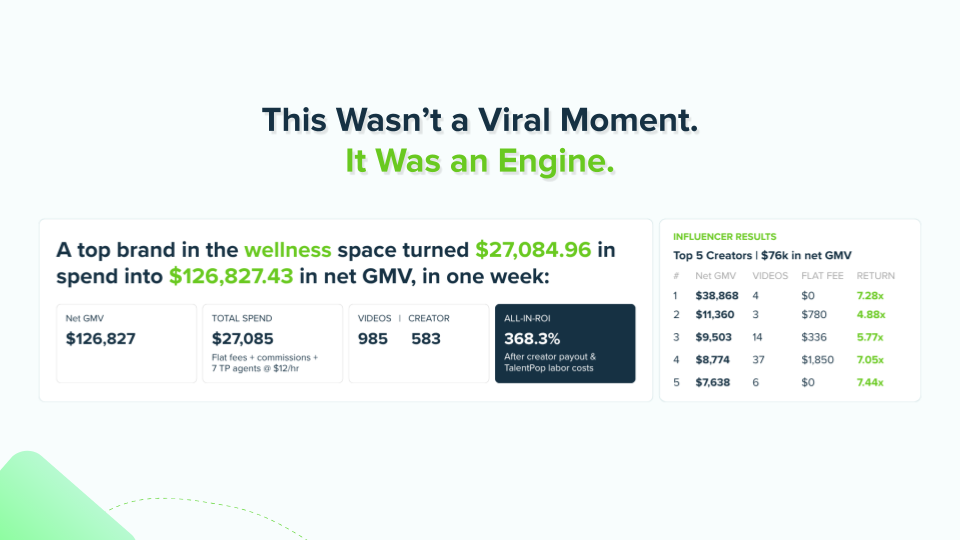
TikTok influencer marketing results for a top wellness E-Commerce brand managed by TalentPop

Starting from zero active creator partnerships, TalentPop's Influencer Marketing Specialist built their entire TikTok affiliate program from the ground up, taking on every step of the process, from sourcing and vetting creators to managing outreach, coordinating shipments, and tracking performance across every post.

The 6-step framework below is how TalentPop's Influencer Marketing Specialists build programs that get there.

TalentPop's 6-Step Plan for TikTok Influencer Marketing Success

The following framework is how TalentPop's Influencer Marketing Specialists build and run TikTok creator programs for E-Commerce brands. Each step is designed to be repeatable, measurable, and scalable, whether you're launching your first campaign or optimizing a program that already exists.

1

Set Clear Goals and Success Metrics

Before reaching out to a single creator, align internally on what this campaign is trying to accomplish. Without defined goals, there's no way to select the right influencer tier, write an effective brief, or measure whether the program is working.

TalentPop's IMS team starts every engagement by establishing three core campaign objectives:

Core Campaign Objectives
➔

Brand Awareness: Expand visibility to relevant TikTok audiences through content and trend integration.

➔

Engagement: Generate comments, shares, and saves by tapping into community-based creators who foster authentic interactions.

➔

Conversions: Drive traffic and purchases through TikTok Shop or custom affiliate links.

With objectives defined, the next step is locking in the KPIs that will track progress. These five metrics form the backbone of any TalentPop IMS campaign dashboard:

KPI What It Measures
Daily Total Outreaches Volume of influencer outreach efforts, tracks pipeline activity and effort consistency.
Monthly Packages Sent Number of products sent to creators for sampling, unboxing, or content creation.
Posts Published Actual influencer content going live, reflects campaign execution and earned reach.
Total Conversions Desired actions (purchases, sign-ups) driven by influencer content or affiliate offers.
Total Revenue Goal Income attributed to influencer activity via code redemptions, affiliate links, or tracked referrals.
2

Identify and Vet Ideal Influencers

With goals locked in, the next step is building a shortlist of creators who can actually deliver on them. This goes well beyond browsing TikTok and picking accounts that look good, it requires a data-backed approach that evaluates fit across multiple dimensions before a single message is sent.

TalentPop's IMS team sources creators primarily through the TikTok Shop Affiliate Center, using platform filters to narrow by niche, engagement rate, Gross Merchandise Value (GMV), and historical performance. This ensures that only creators who have demonstrated the ability to drive action, not just views, make it to the outreach stage.

Before building your shortlist, it's important to understand how the four main creator tiers compare on reach, engagement, and cost, because the wrong tier for your goal is one of the most common reasons E-Commerce brands overspend and underdeliver.

Tier Followers Avg. Engagement Rate Avg. Cost Per Post Best For
Nano 1K–10K 10.3% $50–$250 High-trust communities, early campaign testing, niche product launches
Micro 10K–100K 3–8% $200–$1,500 Niche audience targeting, affiliate-driven conversions, balanced ROI
Macro 100K–1M 1–3% $1,000–$6,000 Broader reach, brand awareness campaigns, credibility signals
Mega 1M+ Under 1% $15,000–$80,000+ Maximum visibility, large-scale product launches, celebrity association

For most E-Commerce brands, a portfolio of micro and nano creators delivers stronger conversion results than a single high-cost macro placement at the same budget. The trust is deeper, the audiences are more targeted, and the cost-per-result is significantly lower.

Choosing the right influencer goes beyond follower count. It's about finding someone who aligns with your brand's voice, values, and audience. When building the ideal creator profile, the IMS evaluates:

Influencer Vetting Criteria
●

Tone and content style, clean, humorous, educational, does it match the brand's voice and energy?

●

Niche relevance: are they already creating content in your product category (skincare, fitness, food, tech)?

●

Audience demographics: do their followers match your target customer in age, gender, and geographic location?

●

Previous brand partnerships: have they promoted similar products before, and what did the performance look like?

●

Follower tier alignment: does their reach and engagement rate fit the campaign's primary goal (awareness vs. direct conversions)?

●

Conversion potential: do their past posts demonstrate the ability to drive audience action, not just passive engagement?

3

Audit Influencer Profiles

A shortlist of promising creators isn't enough. Before outreach begins, each profile goes through a structured audit, because follower count and surface-level engagement can hide problems that will tank campaign ROI. This step ensures every creator selected is both brand-safe and performance-ready.

TalentPop's IMS team runs these audits through the TikTok Creator Marketplace and TikTok Shop Affiliate Center, checking for the following signals:

Profile Audit Checklist
●

Engagement rate: target 2.5%–4%+ as a baseline; higher is better for conversion-focused campaigns.

●

Content quality and consistency: are they posting regularly with production quality that aligns with your brand's positioning?

●

Audience sentiment in comments, are comments genuine and conversational, or generic and bot-like?

●

Past paid collaboration performance, do sponsored posts maintain strong view and engagement numbers, or does performance drop significantly?

●

Gross Merchandise Value (GMV): if available via TikTok Shop, this is the most direct signal of a creator's ability to drive actual purchases.

●

Authenticity signals: flag sudden follower spikes, low comment-to-view ratios, or suspiciously uniform engagement patterns as indicators of inauthentic growth.

Creators who pass the audit move forward to outreach. Those who don't are removed from the list, regardless of how impressive their follower count looks at first glance.

4

Reach Out and Manage Responses

Once the audited creator list is ready, outreach begins. The quality of that first message matters more than most brands realize. Generic, copy-paste DMs get ignored. Personalized, value-led messages that reference the creator's actual content, and make the offer immediately clear, get responses.

TalentPop's IMS sends initial outreach via TikTok's Cooperation Chat or Creator Messages. Every message is short, specific, and written to match both the brand's voice and the creator's style. Here's what that looks like:

Sample Outreach Message, Template

Hey [Username]! 👋

I'm with [Brand], we're a [short brand description, e.g., "sustainable drinkware brand" or "skincare line focused on clean ingredients"] and your vibe is everything!

We're launching a new campaign and think you'd be a great fit. If you join, we'll send you a product to try and set you up to earn X% commission. Wanna check it out?

– [Your Name] | [Brand]

After the initial message goes out, the IMS tracks every reply, sends 2–3 follow-ups for non-responders, and answers questions in real time to convert interest into confirmed partnerships. Response tracking tools keep the pipeline organized and ensure no warm lead goes cold between touchpoints.

5

Finalize Partnerships and Coordinate Shipments

Once a creator confirms interest, the collaboration becomes official with a comprehensive campaign brief. This document is the creator's single source of truth, it eliminates guesswork, reduces back-and-forth, and sets the foundation for content that actually aligns with campaign goals.

What to Include in Every Campaign Brief
●

Campaign overview and brand background

●

Deliverables: e.g., 1 TikTok video post, story reposts

●

Key messages, required hashtags, and preferred sounds

●

Timeline and posting deadlines

●

Compensation details: commission rate, bonuses, or gifting terms

●

Content usage rights or licensing terms

●

Shipping information and estimated product delivery date

Once the brief is confirmed, the IMS coordinates product shipment, verifying the creator's shipping address, product variant, and estimated delivery window. Creators are updated proactively at each stage, which builds trust early and increases the likelihood of on-time, on-brief content.

6

Monitor Performance and Optimize

When a creator publishes, the work isn't done, it's entering its most important phase. Real-time engagement with published content, structured performance tracking, and consistent optimization cycles are what separate brands that build durable influencer programs from those that run one-off campaigns and move on.

How TalentPop Tracks and Optimizes Campaign Performance
●

Attribution tracking: unique affiliate links, TikTok Shop tracking tools, and UTM parameters ensure every conversion is tied accurately to the right creator.

●

30-day performance reviews: engagement rate, conversions, and revenue are assessed monthly to identify top performers, course-correct underperformers, and refine creator selection criteria for future outreach.

●

Creator relationship management: top-performing affiliates receive higher commission rates, cash bonuses, early access to new product launches, and eligibility for paid collaborations.

●

Underperformer communication: creators who miss targets receive transparent feedback, actionable coaching tips, and a clear path to improve before any program changes are made.

Top-performing affiliates aren't just high-converting, they're brand advocates. Nurturing those relationships with structured rewards, consistent communication, and genuine recognition turns one-time posts into long-term partnerships that compound in value with every campaign cycle.

Common TikTok Influencer Marketing Mistakes to Avoid

Most E-Commerce brands don't fail at TikTok influencer marketing because the channel doesn't work. They fail because of avoidable process gaps that compound across a campaign. These are the mistakes that consistently separate underperforming programs from ones that drive real, measurable results.

✕

Choosing creators by follower count alone, A large following doesn't equal a converting audience. Engagement rate, GMV history, and niche relevance matter far more than raw reach when the goal is sales, not impressions.

✕

Skipping the profile audit, Surface-level metrics can disguise bot followers, artificially inflated engagement, and sponsored content that consistently underperforms. An unvetted creator is a budget risk, not an opportunity.

✕

Sending generic outreach messages, Copy-paste DMs signal that you haven't actually watched the creator's content. Personalized, specific messages that reference their niche and make the value clear immediately are the ones that get responses.

✕

Launching without defined KPIs, Without clear metrics agreed on before the campaign launches, there's no way to evaluate what's working, adjust mid-program, or justify continuing investment. Goals must be set before a single creator is contacted.

✕

Running one-off campaigns with no follow-up, A creator who posts once and hears nothing is unlikely to become a long-term advocate. The brands that compound results over time are the ones that build relationships, not just transactional placements.

✕

Ignoring performance data after publishing, Most programs collect data and do nothing with it. The 30-day review cycle exists to surface what's working, double down on top performers, and cut creators who consistently underdeliver regardless of how promising they looked at the start.

Get Started with TikTok Influencer Marketing

TalentPop has run TikTok influencer programs for E-Commerce brands across beauty, health and wellness , food and beverage , apparel, pet care, and consumer tech. The work isn't theoretical. Each engagement follows the same 6-step process outlined above, run by a dedicated Influencer Marketing Specialist who owns every step from creator discovery to performance reporting.

The results are visible from the first few weeks: pipelines full of vetted, brand-aligned creators, outreach going out daily without consuming internal bandwidth, and a performance dashboard that actually tells you what's driving revenue.

Here's what that looks like in practice:

Most E-Commerce brands run influencer marketing inconsistently or not at all, which means the gap between what they're doing and what a structured program delivers compounds month over month.

The comparison below shows what TalentPop's approach produces for a brand at your stage vs. the typical DIY or no-program baseline:
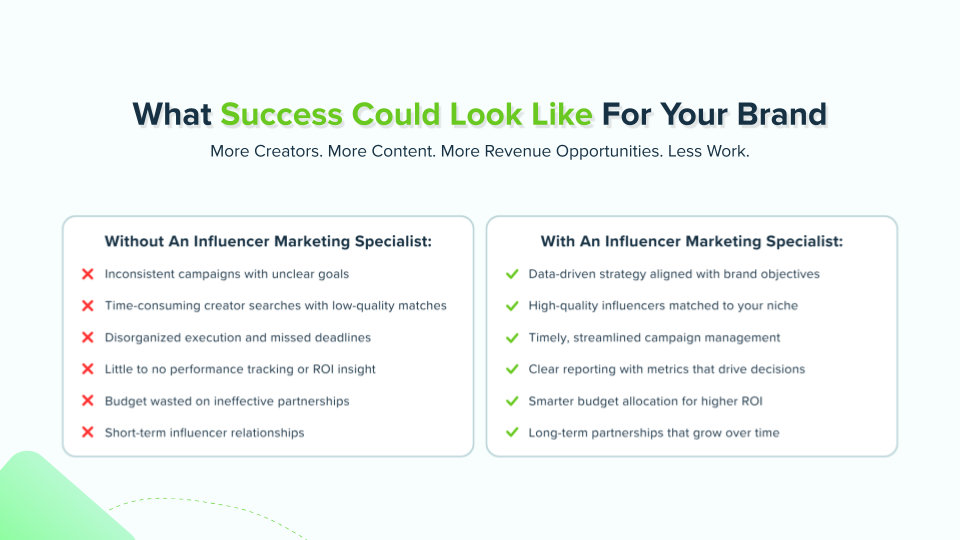
Side-by-side comparison of influencer marketing results for an E-Commerce brand with and without a TalentPop Influencer Marketing Specialist

One of the most common questions brands ask before starting is: what does a specialist actually do all day? The answer is everything your team currently doesn't have time to do consistently. From creator sourcing to outreach to shipment coordination and analytics, a single TalentPop IMS handles the full program. Here's a real snapshot of weekly output:
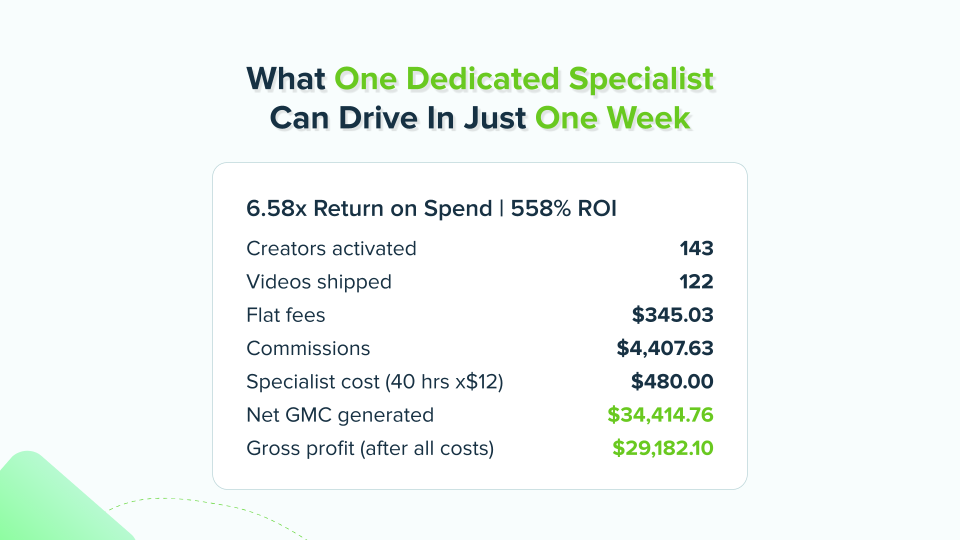
Weekly output and campaign activities driven by one dedicated TalentPop Influencer Marketing Specialist

Beyond what gets done, there's what gets removed from your team's plate entirely. Every hour your team currently spends researching creators, writing DMs, managing shipments, or pulling performance reports is time that gets handed back when TalentPop runs the program. Here's exactly what transfers on day one:
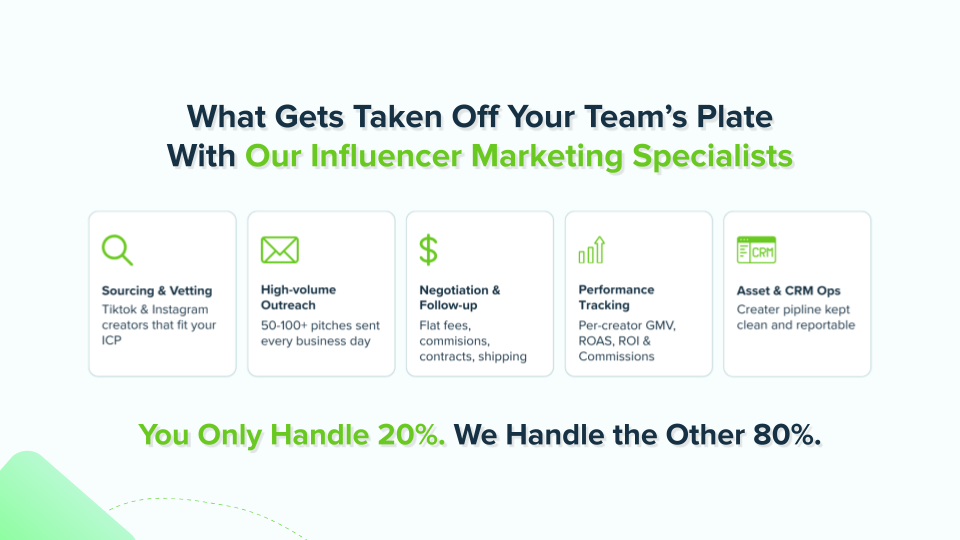
Breakdown of influencer marketing tasks removed from an E-Commerce brand's internal team when working with TalentPop
Ready to Hand This Off to a Specialist?

TalentPop's Influencer Marketing Specialists run your full TikTok creator program, from sourcing and vetting to outreach, shipments, and performance tracking. You've seen the playbook. Let a dedicated specialist run it for you. Book a Call With Our Team

Frequently Asked Questions About TikTok Influencer Marketing

1. How do I determine the right campaign goals for my influencer strategy?

Start by aligning with internal stakeholders on what success looks like. Goals could be brand awareness (visibility), engagement (likes, shares, comments), or conversions (sales via TikTok Shop). Each goal dictates a different influencer type, content style, and tracking method. If you're focused on conversions, prioritize creators with a proven sales record and experience in product reviews rather than creators who excel at reach and entertainment.

2. What KPIs should I track to measure influencer performance?

The five core KPIs are Daily Total Outreaches (effort and pipeline volume), Monthly Packages Sent (product distribution), Posts Published (campaign execution and earned reach), Total Conversions (purchase or action-driven results), and Total Revenue (attributed sales from affiliate links or code redemptions). Tracking all five tells you whether the campaign is both active and producing meaningful outcomes.

3. What makes an influencer a good fit for our brand?

Beyond aesthetics, look for alignment in tone and content style, niche relevance, audience demographics, and past brand partnership performance. A creator who checks every visual box but speaks to the wrong audience, or whose sponsored content historically underperforms, is a poor fit regardless of their follower count. Fit drives authenticity, and authenticity drives conversions on TikTok.

4. What follower size should I target for my campaign?

It depends on your primary goal. Nano (1K–10K) works best for tight-knit communities and high engagement. Micro (10K–50K) offers solid conversion ROI at an accessible cost. Mid-tier (50K–250K) balances reach and performance well. Macro and Mega (250K+) is best suited for broad awareness campaigns. Smaller influencers consistently outperform larger ones on conversion rates because of the deeper trust they've built with their audience over time.

5. How do I audit influencer profiles effectively?

Use the TikTok Creator Marketplace or TikTok Shop Affiliate Center. During your audit, look for an engagement rate of 2.5%–4%+, consistent content quality, authentic audience sentiment in comments, strong performance in past paid collaborations, available GMV data via TikTok Shop, and the absence of bot followers or artificial engagement signals like sudden follower spikes and uniformly generic comments.

6. What should I include in my outreach message to influencers?

Keep it short, specific, and value-driven. Include a personal greeting using the creator's name, a brief explanation of why you specifically chose them (reference something from their content), the offer details (free product, commission rate), and a clear call to action. Avoid generic mass-messaging, the more a creator feels individually chosen, the higher your response rate will be.

7. What's included in a campaign brief sent to influencers?

A strong brief covers the campaign overview, brand background, deliverables (number and type of posts), key messages and required hashtags, preferred sounds, posting deadlines, compensation details, content usage or licensing terms, and shipping and product information. This document eliminates ambiguity, reduces back-and-forth, and sets every creator up to produce content that actually aligns with your campaign goals.

8. How do influencer tiers and promotions work in a managed program?

In TalentPop's IMS framework, influencers start in a baseline tier and advance based on 30-day performance across conversions, revenue generated, and posts published. Top performers unlock higher commission rates and cash bonuses. Creators who underperform for 60 days move down one tier, with transparent communication and coaching to help them improve. This structure keeps the program results-driven and motivating for all parties.

9. How do I manage product shipments to influencers?

Once a creator confirms participation, collect their shipping address, preferred product variant if applicable, and confirm the estimated delivery date with your fulfillment team. Track every package and update the creator proactively. Timely, well-communicated delivery keeps content on schedule and builds trust early in the relationship, which matters for long-term partnership quality.

10. What actions should I take after the influencer receives the product?

Confirm delivery, offer content direction support if they want it, answer any brief questions, and send a gentle reminder of the posting deadline. Proactive communication at this stage keeps the campaign on track and signals to the creator that this is a professionally managed program, which increases their enthusiasm and commitment to producing strong content.

11. What if an influencer doesn't post after receiving the product?

Follow up politely after the expected posting window has passed. Ask whether they need more time or additional creative direction, and offer to resend the brief. If there's still no response after 2–3 follow-up attempts, document the outcome and move on. Use the experience to refine your vetting criteria and identify early red flags, like low response rates during outreach, to reduce this from happening in future campaigns.

12. How do I track conversions and revenue from influencers?

Use unique affiliate links or discount codes assigned to each creator, TikTok Shop's built-in tracking infrastructure, and UTM parameters for any traffic driven to an external site. Accurate attribution is critical, not just for measuring ROI, but for ensuring creators receive correct compensation and for making informed decisions about who to continue investing in across future campaign cycles.

13. How do I reward top-performing influencers?

High-performing creators should receive recognition and tangible rewards: increased commission rates, early access to new product launches, personalized gifts, or eligibility for paid collaborations. These creators are driving real revenue for your brand, investing in loyalty with them produces compounding returns that strengthen with every campaign cycle.

14. Can an influencer be demoted? How is that handled?

Yes. Creators who don't meet performance targets over a 60-day window are moved down one tier. The process should always be handled with transparency and empathy, communicate the reason clearly, share specific and actionable tips to help them improve, and outline exactly what they need to do to re-earn their previous status. The goal is to motivate consistent performance, not to penalize creators who hit a rough patch.

15. How often should I review influencer performance?

Every 30 days. This review window is long enough to capture meaningful content impact and track conversion patterns, but short enough to course-correct quickly before budget is wasted. Use each monthly review to promote high performers, re-engage creators who need support, refine your vetting criteria, and remove partnerships that consistently underdeliver despite coaching and follow-up.

Build a TikTok Influencer Program That Delivers Consistent Results

TikTok influencer marketing works. The platform's algorithm, its native commerce infrastructure, and the trust creators have built with their audiences make it the highest short-term ROI influencer channel available to E-Commerce brands right now. But results don't come from picking random creators and hoping for the best. They come from a structured, repeatable process, executed consistently across every step, from goal-setting to performance optimization.

The 6-step framework above is how TalentPop's Influencer Marketing Specialists build and run creator programs for E-Commerce brands every day. Each step is designed to eliminate guesswork, reduce wasted spend, and produce measurable outcomes that compound over time.

If you're ready to launch or scale a TikTok influencer program without adding more to your internal team's workload, TalentPop's dedicated specialists are ready to take it on, from the first creator audit to the last performance report.

Let a Specialist Run Your TikTok Influencer Program

TalentPop's Influencer Marketing Specialists handle every step of your TikTok creator program, from finding and vetting creators to managing outreach, coordinating shipments, and tracking performance. You get the results without the operational lift. Book a Call With Our Team

Need Help With Customer Service?

Book a call with one of our specialists today to see how TalentPop can assist you with putting together a solution for your customer service needs.

Book a Call
Need Help With Customer Service?

We're elevating customer experiences at 500 top E-Commerce brands (and counting). Let's see what we can do for you!

Get Started
Need Help With Customer Service?

We're elevating customer experiences at 500 top E-Commerce brands (and counting). Let's see what we can do for you!

Try TalentPop Risk-Free

No contracts, No commitments Guaranteed results.*
I can't even put into words what a great experience we've had with TalentPop.
Jenn Angel
We want everyone on our team to be from TalentPop!
Jarett Castillo