


.png)
Speed is the most important factor in any customer service interaction, and 88% of customers expect faster replies in 2026 than they did a year ago (Zendesk CX Trends 2026). For E-Commerce brands running lean teams across multiple channels, that pressure is constant. But speed is only one part of the equation. The customer service types you offer, the approach behind them, and the team executing every interaction all determine whether a customer buys again or quietly moves on. In this guide, we break down the 9 types of customer service and show E-Commerce brands exactly which ones to prioritize to improve satisfaction, reduce churn, and drive measurable revenue.
What Is Customer Service?
Customer service is every interaction a brand has with a customer across the entire lifecycle of their relationship, from pre-purchase questions to post-order support and everything in between. For E-Commerce brands specifically, it is the primary lever for turning one-time buyers into loyal repeat customers, because unlike physical retail, you rarely get a face-to-face moment to build that relationship.
The stakes are higher than most teams realize. 30% of consumers will not give a brand more than one chance after a poor support experience (Hiver, 2025). Unhappy customers rarely complain directly; they simply stop buying and tell others. The 9 types of customer service below are the channels and strategies your brand can deploy to get ahead of that problem before it costs you revenue.
The 9 Types of Customer Service
Live chat support is real-time messaging between a customer and an agent or bot conducted directly on your website, app, or storefront. E-Commerce brands use it to answer product questions, reduce cart abandonment, and resolve post-purchase issues before they escalate into returns.
It is the highest-performing channel for conversion: visitors who engage in live chat are 2.8 times more likely to buy than those who do not (ICMI via Ringly). That multiplier is why live chat consistently tops satisfaction scores across all support channels and why brands that add it see measurable lifts in both revenue and CSAT within weeks. One factor that is easy to overlook: the majority of live chat conversations now happen on mobile devices, which means your chat widget must be optimized for small screens to capture the customers who actually use it.
Best for: cart abandonment, pre-purchase questions, order status, upselling
Email support is asynchronous written communication that allows customers to submit detailed questions and receive thorough responses at their own pace. E-Commerce brands use it for returns, warranty claims, order discrepancies, and any issue that requires a written paper trail.
Despite predictions of its decline, email remains one of the most relied-upon CS channels. 68% of shoppers still use email for customer service, particularly for complex issues, returns, and anything requiring a paper trail (eDesk, 2025). The gap to close is response time: shoppers expect a reply within the hour, while most brands take far longer. A dedicated email agent using a helpdesk like Gorgias closes that gap and turns email from a lagging channel into a reliable one.
Best for: returns, warranties, order issues, anything requiring documentation
Phone support is voice-based communication between a customer and a live agent, used for complex, urgent, or emotionally sensitive issues that require real-time, personalized attention. E-Commerce brands use it for high-value order disputes, product troubleshooting, and situations where a written channel is simply not enough.
Customers pick up the phone when the issue is serious. A large portion of shoppers across every generation, including Gen Z, will default to a phone call when they cannot resolve something on their own, which challenges the assumption that voice support is becoming obsolete. For E-Commerce brands, the job is not to eliminate phone support but to make it efficient: a helpdesk that logs call history, creates tickets automatically, and routes calls by issue type means no conversation is ever lost or repeated from scratch.
Best for: high-value disputes, technical troubleshooting, urgent or emotionally sensitive issues
Self-service support covers any resource that lets customers resolve their own issues without contacting an agent: FAQ pages, help centers, knowledge bases, return portals, and order tracking tools. E-Commerce brands use it to handle high-volume, repetitive inquiries at near-zero incremental cost.
81% of customers attempt to solve their problem independently before reaching out to a live agent (Harvard Business Review). That means a well-built self-service layer is not a nice-to-have; it is the first place most of your customers go. The important distinction is between self-service that actually works and self-service that frustrates. A knowledge base that answers real questions, a return portal that processes without friction, and a tracking page that provides genuine visibility will deflect tickets and improve satisfaction at the same time. Self-service that sends customers in circles forces them onto your most expensive channels instead.
Best for: order tracking, return requests, account FAQs, policy questions
Social media customer service is support delivered through public posts, comments, and direct messages on platforms such as Instagram, TikTok, Facebook, and X. E-Commerce brands use it to resolve complaints publicly, manage brand reputation, and meet customers on the platforms they already spend time on.
What makes this channel uniquely powerful and uniquely risky is its transparency. A public response to a complaint is visible to every follower and potential customer who sees it. Brands that handle public complaints with speed and genuine care routinely turn those moments into the most visible demonstrations of their service quality. Brands that ignore or dismiss them give the original complaint an audience it would never have had. The job here is not simply to respond; it is to respond well enough that onlookers become buyers.
Best for: complaint resolution, community building, brand reputation management
AI-powered support uses machine learning, large language models, and automated workflows to handle customer inquiries, triage tickets, and assist human agents in real time. E-Commerce brands use it to provide instant responses around the clock, reduce first-response times, and free agents to focus on complex or high-value interactions.
AI adoption in E-Commerce customer service has accelerated sharply over the past two years, and the resolution rates of AI tools have improved significantly as the underlying models have matured. The most effective teams run a hybrid model: AI handles volume, triage, and routine questions while human agents handle the interactions that require empathy, nuance, and brand judgment. AI and humans are not alternatives to each other; they are a stack. The brands that treat them as competing choices are the ones still burning agent time on repetitive tickets that a well-configured bot could resolve in seconds.
Best for: 24/7 coverage, order status, FAQs, ticket triage, agent copilot
Omnichannel support is a unified customer service experience where context, including previous conversations, order history, preferences, and open tickets, travels with the customer regardless of which channel they use. E-Commerce brands use it to eliminate the most common and most frustrating support failure: customers having to repeat themselves every time they switch channels.
This is the difference between multichannel (available everywhere) and omnichannel (connected everywhere). A customer who starts on live chat, follows up by email, and calls the next morning should be greeted with full context every time, not a blank slate. Most E-Commerce brands that struggle with high repeat-contact rates are dealing with a channel disconnect problem, not a staffing problem. Platforms like Gorgias are built for exactly this, pulling Shopify order data, email threads, and chat history into a single agent view so the conversation never has to start over.
Best for: brands managing 3+ channels, subscription brands, high-AOV products
SMS and messaging app support delivers customer service through text messages, WhatsApp, Facebook Messenger, and similar platforms, meeting customers on the channels they use for personal communication. E-Commerce brands use it for order confirmations, shipping updates, post-purchase follow-up, and two-way support for quick questions that do not warrant an email or phone call.
Mobile commerce continues to grow as a share of total E-Commerce revenue, and customers who shop on their phones expect support on their phones too. SMS as a support channel has a natural advantage: it requires no app download, no login, and no wait for a page to load. For subscription brands in particular, SMS has become the most effective channel for renewal reminders, restock alerts, and loyalty touches that keep customers engaged between purchases. WhatsApp support, where it is available, is the most requested option among global shoppers.
Best for: shipping notifications, subscription reminders, post-purchase follow-up, quick FAQ
In-person customer service is face-to-face assistance delivered at a physical retail location, pop-up event, or brand showroom. E-Commerce brands with a retail footprint, or those expanding into wholesale or flagship stores, use it to deliver a brand experience that no digital channel can fully replicate.
For primarily online brands, in-person support becomes most relevant during seasonal pop-ups, trade shows, brand activations, or partnerships with physical retailers. The goal in these moments is consistency: the warmth and product knowledge your online CS team is known for should transfer directly to any face-to-face interaction. Brands like Gobi Heat, which expanded into major retail stores like Cabela's while maintaining their online CS operations with TalentPop, demonstrate that the two can scale in parallel without one compromising the other.
Best for: premium products, brand activations, wholesale retail expansion
At a Glance: Comparing All 9 Types of Customer Service
Here is how all 9 types compare on the dimensions that matter most to E-Commerce brands. Use this to decide which channels belong in your support strategy and which ones to prioritize first.
How to Choose the Right Types of Customer Service for Your Brand
The best type of customer service is the one your customers actually use. Before adding a new channel, run through four questions:
Most E-Commerce brands see the best results with 3 to 5 channels executed consistently rather than spreading thin across all 9. Quality of coverage beats quantity of channels every time.
simplehuman is a useful example of what this looks like in practice. When they came to TalentPop managing over 800 inbound tickets per day, the answer was not more channels; it was the right team structure for the volume they were running. We onboarded three agents within weeks to handle lower-priority tickets, which freed their internal team to focus on complex inquiries. Within months the team grew to 14, with the top-performing agent across their entire CS operation, internal staff included, being one of the original three we placed. The channel mix did not change. The support model did. Read the full success story here.
Reactive vs. Proactive Customer Service: Two Approaches That Define Your Strategy
Reactive customer service responds to customers after they reach out; proactive customer service reaches out before the customer needs to. Every channel and type listed above can operate in either mode. The channel itself is not what makes your CS proactive; the mindset and staffing behind it are.
Most E-Commerce brands operate reactively by default. Agents answer tickets, resolve issues, and close conversations. That is a necessary foundation, but it leaves significant value on the table. Proactive touchpoints, such as a shipping delay alert sent before the customer notices, a subscription save call made before a cancellation processes, or a cart recovery message sent within 60 minutes, consistently outperform reactive responses at every metric that matters: CSAT, retention rate, and revenue per customer.
The channel does not change; email is still email, SMS is still SMS. But the direction of the outreach is what transforms a cost center into a growth engine.
Why E-Commerce Brands Should Use a Proactive Approach
Most E-Commerce brands choose their customer service channels carefully, then run all of them reactively. They set up live chat and wait for customers to start conversations. They add email and respond when tickets arrive. They launch SMS for shipping updates and move on. The channel is rarely the problem. What determines whether customer service drives revenue or simply manages complaints is the approach running behind it.
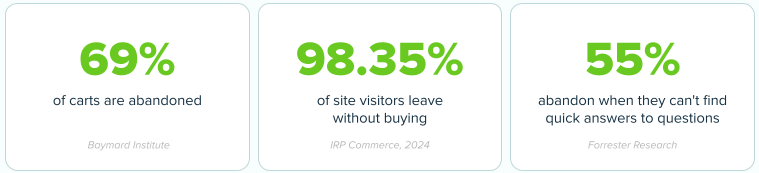
A significant portion of visitors leave an E-Commerce store without buying, not because of price or product, but because they had a question and no one was there to answer it at that moment. The channel was available. The presence behind it was not. Most brands accept this as a fixed cost of running an online store. The ones that treat customer service as a growth function do not.
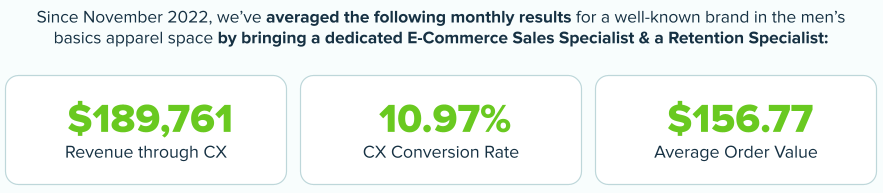
When TalentPop agents engage customers proactively at the right moment with the right message, the conversion numbers change materially. One brand working with TalentPop reached a 10% conversion rate through proactive live chat. The channel was live chat, a tool most brands already have. What changed was who initiated the conversation, and when.
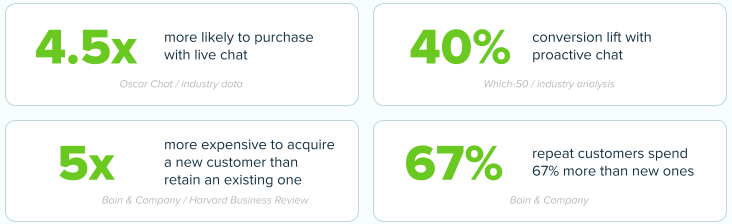
This is the distinction that matters most when evaluating your customer service setup: not which channels you have, but whether the people or AI behind those channels are waiting for contact or creating it. The brands that treat CS as a revenue function staff for proactive outreach. The ones that treat it as a cost center staff for coverage. Both can be using the same 9 channel types. The results are not the same.
Frequently Asked Questions
The Bottom Line on Customer Service Channels
Choosing the right types of customer service is worth doing carefully. But the decision does not end at the channel. The brands that consistently outperform on retention, conversion, and lifetime value are not the ones with the most channels; they are the ones with the clearest sense of how each channel should be staffed and what role it plays in the customer journey.
Reactive live chat closes tickets. Proactive live chat drives sales. A proactive one is a revenue tool. A self-service portal customers cannot navigate is a ticket-generating problem disguised as a solution. An email team with a 12-hour response time is costing the brand customers it will never know it lost. The channel type creates the opportunity. The execution determines whether that opportunity is captured.
Getting both right, the right channels and the right people running them, is where E-Commerce brands find the separation.

Need Help With Customer Service?
Book a call with one of our specialists today to see how TalentPop can assist you with putting together a solution for your customer service needs.
Book a CallNeed Help With Customer Service?
We're elevating customer experiences at 500 top E-Commerce brands (and counting). Let's see what we can do for you!
Get Started

.png)

.png)


